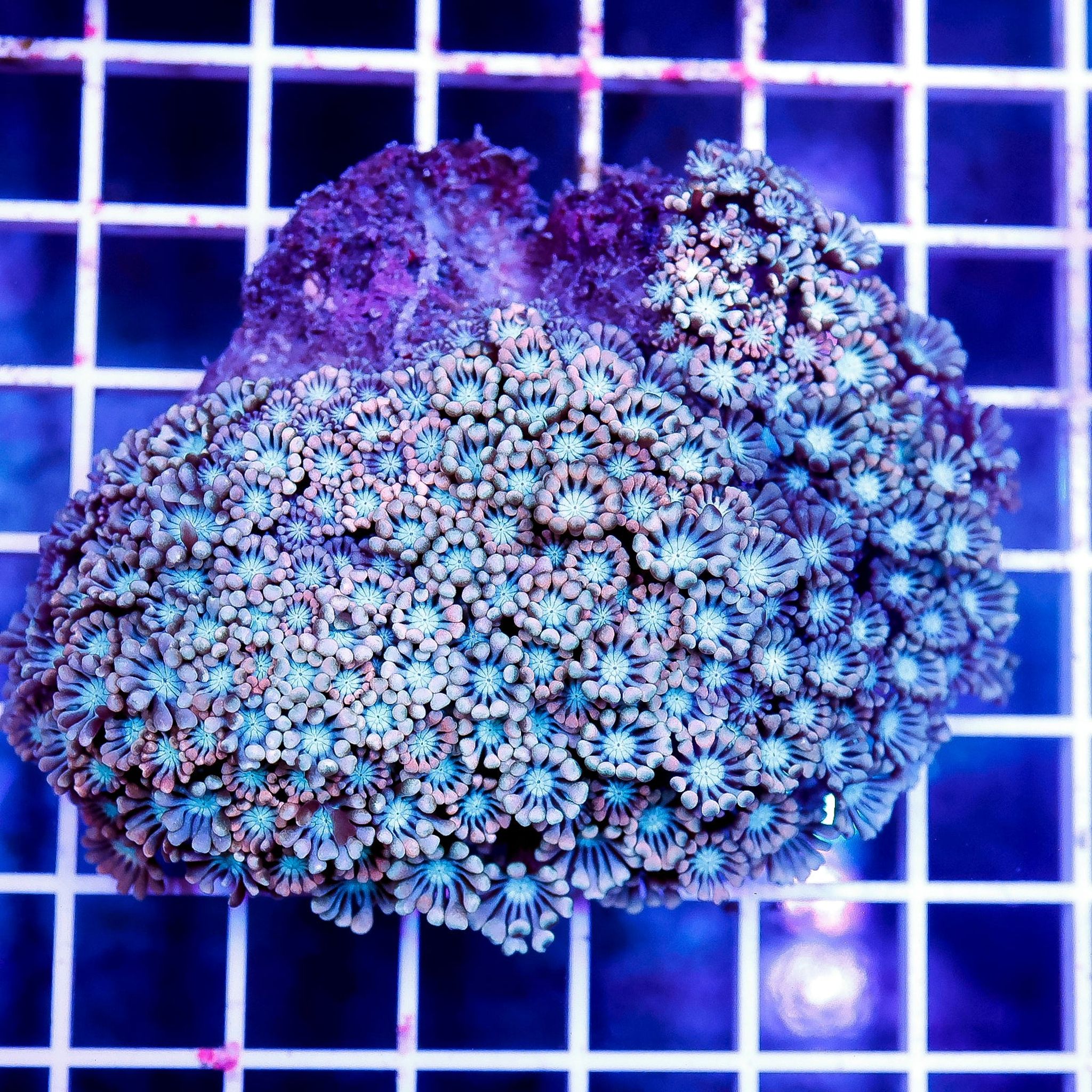
Best Placement for Alveopora: PAR, Flow and Space Requirements
Alveopora rewards a low-and-slow approach: modest light, gentle flow, and generous elbow room. This guide gives the specific numbers — PAR range, flow strength, and clearance in inches — so you can pick a spot with confidence instead of guessing and watching the colony recede.
Why Placement Matters So Much for This Coral
Alveopora is a flowerpot-type LPS coral, often confused with the closely related Goniopora, but it actually sits in the Acroporidae family and is taxonomically distinct from it. One easy visual tell: Alveopora polyps carry roughly 12 tentacles each, compared to Goniopora's 18–24, which gives Alveopora a fuller, "flowerier" look when fully extended.
In the wild, Alveopora grows on shallow, turbid, nutrient-rich inshore reefs where light penetration is low to moderate and water movement is gentle. That native habitat is the entire basis for placement advice — this is not a bright-light, high-flow SPS-style coral, and treating it like one is the fastest way to stress it.
Target PAR: 50–100
Aim for 50 to 100 PAR at the coral's final position. That's a medium-low intensity band, and within it, err on the low side rather than the high side — overexposure is a bigger risk for Alveopora than underexposure. The coral also tends to look fairly consistent across that range, so there's no real payoff to pushing light higher chasing better color.
A minority of keepers do report thriving colonies under brighter light and stronger current, usually near the top of the tank. Treat that as evidence the genus has some flexibility, not as a reason to start there. Begin conservative, and let the coral's own behavior tell you whether to adjust.
Matching a Fixture to This PAR Window
Spectrum matters more than raw intensity or color temperature when choosing an LED system for Alveopora. A fixture with a documented spectrum graph and a mix of actinic plus full-spectrum output will generally serve this coral better than one marketed purely on peak PAR output. If you're shopping for a light, browse LED lighting options and check the spectrum chart before the PAR number.
If you know the PAR value the colony was already growing under before you acquired it, try to match that at your new placement — it removes most of the guesswork. Otherwise, use a PAR meter, or the fixture manufacturer's PAR chart combined with your tank's dimensions, to work out which shelf height in your specific tank lands in the 50–100 PAR window.
Depth-to-PAR Starting Points
No single formula fits every fixture, but this table gives a practical starting point for a standard reef LED run at typical reef intensity over an open-top or low-iron glass tank. Confirm with a meter once the light is installed — output varies a lot between fixtures and mounting heights.
| Tank water depth | Likely low-PAR zone (bottom/sand) | Likely mid-PAR zone (mid rock) | Likely high-PAR zone (near top) |
|---|---|---|---|
| 12 in (30 cm) | 30–60 PAR | 80–130 PAR | 150+ PAR |
| 18 in (46 cm) | 30–60 PAR | 60–100 PAR | 120–180 PAR |
| 24 in (61 cm) | 40–70 PAR | 50–100 PAR | 100–160 PAR |
| 30 in (76 cm) | 40–80 PAR | 50–90 PAR | 90–140 PAR |
For most standard-depth reef tanks, the sand bed or the lowest rock shelf lands closest to the 50–100 PAR target without any extra shading.
Placement Zone: Low Tank First
The safest default is lower to mid tank — directly on the sand bed, on a flat rock or tile resting on the substrate, or on the lowest rock shelf. Plenty of keepers frag Alveopora and simply set the piece on a tile or a frag plug on the sand rather than mounting it up on the rockwork at all.
Mid-tank rock ledges can work, but only once you've confirmed the PAR and flow at that exact spot — with a meter, or through close observation of polyp behavior over a week or two. Don't assume a shelf is fine just because it looks like a typical LPS spot; measure or watch first.
Signs your placement is working:
- Polyps stay extended for most of the day
- Tentacles sway gently rather than whipping or lying flat
- No tissue recession at the base or between polyps
- Color stays steady rather than paling out
Flow: Medium, Indirect, Never a Direct Blast
Alveopora wants medium, gentle-to-moderate flow, and it should be indirect or turbulent rather than a direct laminar jet from a powerhead. Polyps should stay extended and sway gently in the current — visible retraction is the coral telling you flow (or light) is too strong at that spot.
As with PAR, some tanks report success with stronger current, so use these numbers as a starting point to dial in by observation rather than a hard limit. Point powerheads at rockwork or the glass to break up the stream before it reaches the coral, rather than aiming water directly at it.
Space and Clearance: 4–8 Inches on Every Side
Give Alveopora 4 to 8 inches (10–20 cm) of open space in every direction from neighboring corals and rockwork. Its tentacles can extend several inches — up to roughly 5 inches (13 cm) — when fully open, and they're delicate.
This is worth restating because it's commonly misunderstood: the priority is protecting the Alveopora's own tissue from abrasion, not protecting its neighbors from it. That leads into the aggression question directly below.
Is Alveopora Aggressive?
General coral-aggression guides often lump all flowerpot-type corals together as having stinging sweeper tentacles, but hobbyist consensus on Alveopora specifically is that it's peaceful — its tentacles are built for feeding, not for warfare with neighboring colonies. Still, give it generous spacing anyway. The risk runs the other direction: rock, encrusting corals, or a genuinely aggressive neighbor can shred or sting Alveopora's own extended tentacles.
Good tankmate practice:
- Place it near other peaceful, low-aggression LPS
- Keep it well away from corals with real sweeper tentacles, such as Euphyllia or Galaxea
- Leave a buffer zone that accounts for outward growth, not just the frag's current size
Growth and Spacing Over Time
Alveopora spreads as it encrusts, and the 4–8 inch clearance you gave a small frag will shrink as the colony grows outward. Check spacing every few months rather than only at initial placement, and be ready to relocate a neighboring coral — or trim back an encroaching one — before tentacles start making contact.
Water Parameters: Stability Over Precision
Standard reef-tank stability matters more than hitting exact numbers. Reasonable targets are:
| Parameter | Target range | Note |
|---|---|---|
| Calcium | ~420–425 ppm | Support with dosing or water changes as needed |
| Alkalinity | 8–9 dKH | Keep swings small week to week |
| Magnesium | Balanced with Ca/Alk | Low magnesium impairs calcium and alkalinity uptake |
| Nitrate/Phosphate | Tolerant of moderate levels | See nutrient note below |
Because Alveopora's native habitat is nutrient-rich, it tolerates — and may even benefit from — slightly higher nitrate and phosphate than many LPS care guides recommend for ultra-low-nutrient, SPS-focused systems. You don't need to chase pristine water to keep this coral healthy; consistent, moderate parameters over time beat chasing "ideal" numbers on any single test.
Feeding: Broadcast, Don't Target
Alveopora benefits from regular feeding of small particulate or plankton-sized foods, but with many small polyps packed together, precise target-feeding is difficult. A broadcast or "shotgun" approach — turning off flow briefly and dispersing fine food over the colony — usually works better than trying to feed individual polyps.
Watch for a "pogo-stick" reaction: one polyp quickly retracts and then slowly re-extends. That's a normal feeding response, not a sign of distress.
Fragged vs. Wild Colonies
Aquacultured or fragged Alveopora acclimates and survives far better than wild-collected colonies. Wild pieces often arrive with boring or encrusting pests hidden inside the coral's porous skeleton, which can be difficult to detect and treat after the fact.
If you do bring in a wild-collected piece, a careful quarantine and dip protocol reduces risk considerably:
- Quarantine separately for at least 2–4 weeks before adding it to the display
- Inspect the skeleton closely for boring worms, small crabs, or unusual holes
- Use an appropriate coral dip according to the product's instructions during quarantine
- Re-inspect after dipping, and repeat if pests are still visible
- Only move it to the display once polyps are extending normally and no pests reappear
Alveopora vs. Goniopora: Difficulty Compared
Alveopora is generally considered moderate difficulty — more forgiving than Goniopora, which has a reputation for a slow, frustrating decline after the first six months or so in captivity. That said, "easier than Goniopora" isn't the same as "set and forget." Alveopora still rewards stable, patient husbandry: consistent parameters, correct light and flow, and a spot that isn't disturbed often.
Browse available LPS hard corals if you're comparing Alveopora against other flowerpot-type or fleshy LPS options for your system.
Common Mistakes to Avoid
- Placing it high in the tank for better color. This is the single most common cause of bleaching and tissue recession in Alveopora. If it happens, move the colony lower and shade it while it recovers.
- Blasting it with direct powerhead flow. Direct current causes tissue damage and chronic polyp retraction. Redirect flow so it's indirect and turbulent instead.
- Crowding it against rock or other corals. Tentacle tips get shredded on rock or stung by neighbors even though Alveopora itself isn't aggressive. Reassess spacing as the colony grows, not just at first placement.
- Buying wild colonies expecting Goniopora-like fragility. The actual risk with wild pieces is different — hidden boring pests in the skeleton — which is why fragged, aquacultured specimens are the more reliable choice.
- Giving up on feeding after target-feeding fails. Switch to broadcast feeding of fine particulate foods during a flow pause instead of trying to feed individual polyps.
- Assuming a closed colony is dead. Alveopora can stay closed for extended stretches when stressed by light, flow, or water quality. Check for tissue recession and odor, and correct placement before assuming the worst.
Frequently Asked Questions
What PAR does Alveopora need?
Roughly 50–100 PAR is the target range. When in doubt, err toward the lower end — overexposure causes more problems for this genus than underexposure does.
Does Alveopora need high flow like SPS corals?
No. Alveopora prefers medium, gentle-to-indirect flow rather than the strong, direct current many SPS corals thrive under. Direct current can damage its fleshy polyps and cause chronic retraction.
How much space does Alveopora need from other corals?
About 4–8 inches (10–20 cm) of clearance on every side. That space mainly protects Alveopora's own extended tentacles from abrasion, since it isn't a strongly aggressive coral.
Is Alveopora aggressive, or does it have sweeper tentacles?
Generally no. Unlike some other flowerpot-type corals, hobbyist consensus treats Alveopora as peaceful, with tentacles built for feeding rather than stinging neighbors. Space is given to protect its own tissue, not to contain aggression.
Where's the best spot in the tank — sand bed or rockwork?
A sand bed, a frag tile, or the lowest rock shelf are the most consistently successful spots. A mid-tank rock ledge can also work, but only after confirming that PAR and flow at that exact spot fall in the recommended ranges.
Why is my Alveopora not opening or staying closed?
The most common causes are too much light or flow at its current spot, or normal acclimation stress after a recent move. Relocate it lower and calmer, then monitor for about a week before making further changes.
Do I need to feed Alveopora directly?
It benefits from feeding, but individual polyps are hard to target-feed given how many there are. Broadcasting fine plankton or particulate foods during a brief flow pause works better than trying to feed each polyp.
Is Alveopora harder to keep than Goniopora?
No — it's generally considered more forgiving and more stable long-term than Goniopora, as long as you follow the light, flow, and spacing guidelines above. It still isn't a "set and forget" coral, though.
Once you've settled on a placement, you can browse current corals on FishyHub to find an Alveopora frag or colony that fits your tank's PAR and flow profile.

