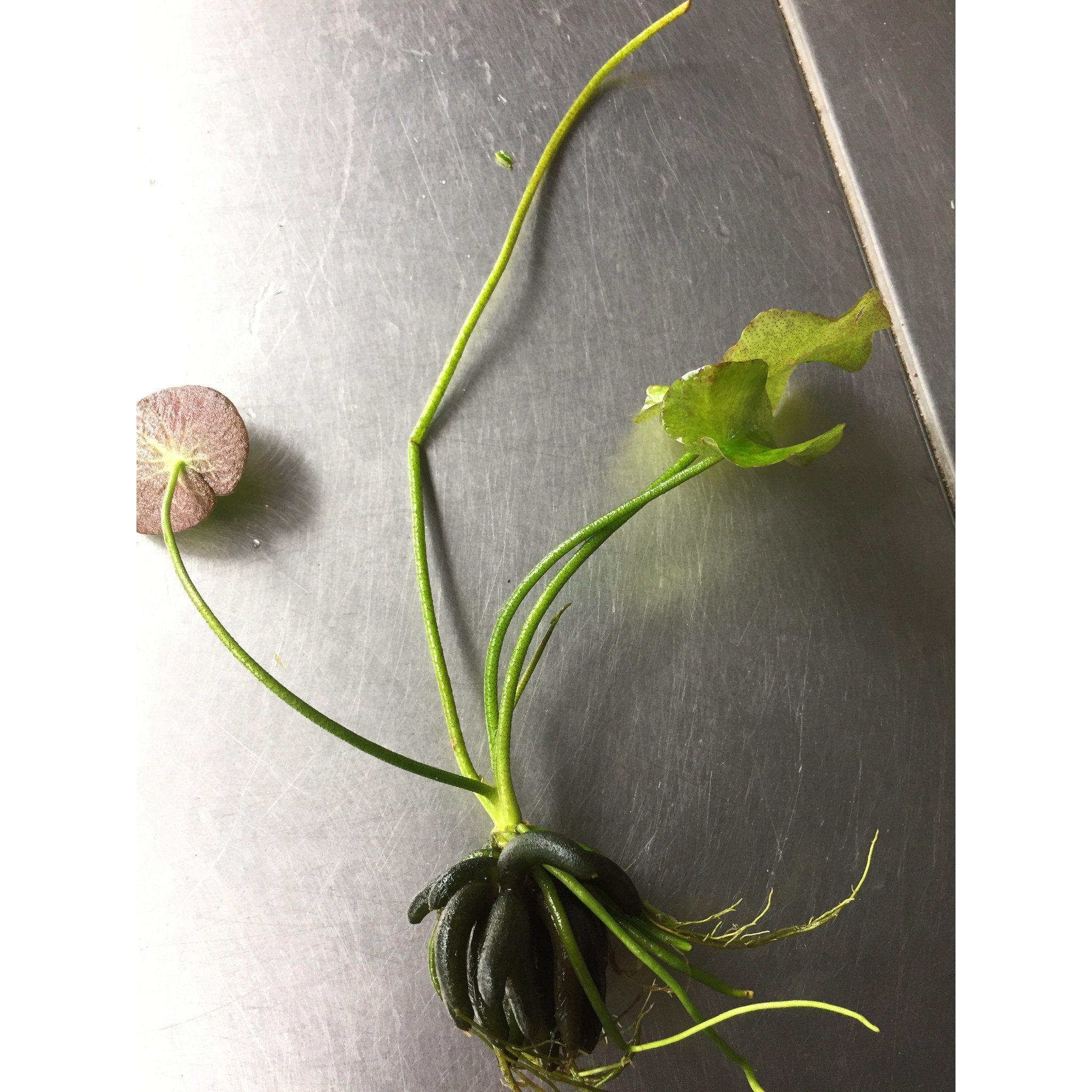
Banana Plant Care Guide: Light, CO2, Substrate and Growth Tips
The banana plant (Nymphoides aquatica) is a slow-growing, low-tech-friendly aquarium plant that gets its name from the banana-shaped tuber clusters at its base. This guide covers exactly how much light and CO2 it needs (spoiler: not much), the planting technique that prevents the single most common way people kill it, and honest expectations for its growth and lifespan.
What Is a Banana Plant?
Nymphoides aquatica is native to the southeastern United States, making it one of the few truly domestic aquatic plants sold for home tanks. It stores energy in clusters of thick, elongated tubers that resemble small bunches of bananas — hence the common name. Those tubers anchor the plant, feed new leaf and runner growth, and are the part most hobbyists accidentally damage during planting.
It's an amphibious plant: underwater it produces rounded, arrowhead- or heart-shaped leaves, but if a runner reaches the surface, it switches to floating lily-pad-style leaves and can even flower with small white or yellow blooms above the waterline.
Light Requirements
Banana plants tolerate low light, but they don't thrive in it. Under dim lighting, expect thin, stretched stems racing toward the surface in search of brighter conditions. Under moderate to high light (roughly 40+ PAR), growth is noticeably faster, leaves stay broader and more compact, and the plant is far less likely to bolt upward.
- Photoperiod: 8–10 hours per day is sufficient.
- Low light: survivable, but expect leggy growth and a plant that constantly reaches for the surface.
- Moderate–high light: best overall shape, denser leaves, and faster propagation via runners.
If you're setting up a new low-tech tank, a basic LED fixture from FishyHub's LED lighting selection is enough to keep a banana plant compact without pushing you into high-tech territory.
Does a Banana Plant Need CO2?
No. CO2 injection is entirely optional for this species and is not required to keep it alive or healthy. Adding CO2 mainly does two things: it speeds up overall growth, and it helps keep leaves denser and more likely to stay underwater rather than racing to the surface for more efficient gas exchange. Think of CO2 as an upgrade you can add later, not a starting requirement — a basic low-tech tank with just light and substrate will grow this plant just fine, only more slowly.
A Quick Primer on Planted-Tank CO2 Systems
Since the banana plant doesn't need CO2, here's a short rundown in case you're considering it for other plants in the same tank:
| Method | Cost/Complexity | Consistency | Best For |
|---|---|---|---|
| Pressurized CO2 (canister, regulator, solenoid) | Highest | Most precise | High-tech, high-light tanks |
| DIY yeast CO2 | Low | Inconsistent, needs frequent recharging | Small tanks, budget setups |
| Liquid carbon supplements | Low, no equipment | Mild, easy to dose | Low-tech tanks wanting a small boost |
A common starting point with pressurized systems is roughly 1 bubble per second per medium-sized tank, then fine-tuned against a drop checker until it reads lime-green. Too much CO2 stresses fish — watch for gasping at the surface — while too little limits plant growth and does little to control algae. None of this is necessary for a banana plant on its own, but it's useful context if you're mixing it with more demanding species in the same aquarium.
Substrate and Planting Technique
Banana plants feed through both their roots and the water column, so substrate matters more than the "just float it" reputation some low-tech plants have.
- Use at least 1.5–2 inches (about 4–5 cm) of gravel, sand, or aquasoil.
- Because it's a genuine root feeder, a nutrient-rich substrate or occasional root tabs noticeably improve growth.
- FishyHub stocks basic gravel and sand substrate suitable for this kind of setup.
The Planting Rule That Prevents Rot
This is the step that causes the most confusion, and getting it wrong is the number one reason banana plants fail:
- Rest the tuber on top of the substrate, or press it in just enough to anchor it — no more than about 1/4 inch (0.6 cm) deep.
- Tuck the thin roots into the substrate, but leave the crown (growth point) fully exposed.
- Never bury the tuber body itself. A fully buried tuber is cut off from oxygen and will rot.
- Space multiple tubers 4–6 inches (10–15 cm) apart so leaves don't crowd into a dense mat.
If you've already planted one too deep and notice a soft, mushy tuber, replant it shallower immediately — that's usually recoverable if leaf growth hasn't stopped.
Water Parameters
| Parameter | Range |
|---|---|
| Temperature | 68–82°F (20–28°C) |
| pH | 6.0–7.5 |
| Hardness | Soft to moderately hard |
Alkaline or very hard water tends to stall growth, so if your banana plant looks stunted despite good light and fertilizing, testing your water parameters is worth doing before assuming a lighting or nutrient problem.
Growth Habit, Size, and Placement
Submersed, a banana plant typically reaches 4–8 inches (10–20 cm) tall, though it will grow taller if a runner reaches the surface in a deeper tank. It works well as a midground plant in standard tanks and as a foreground plant in nano setups.
Tank depth actually changes how the plant behaves:
- Shallow or nano tanks (under about 12 inches / 30 cm deep): runners reach the surface quickly, so expect floating leaves sooner unless you trim aggressively.
- Deeper tanks: the plant stays submersed longer before reaching the surface, giving you more control over its shape.
Once a leaf reaches the surface, it photosynthesizes more efficiently than a submersed leaf and can start outcompeting the plant's underwater growth for energy — another reason to trim runners if you want a fully submerged look.
Growth rate is slow to moderate. A liquid fertilizer or root tabs dosed every few weeks to monthly makes a visible difference in leaf size and speed.
Trimming
Pinch off surface runners and floating leaves periodically if you want the plant to stay compact and fully submerged. This isn't optional maintenance for looks only — left unchecked in a low-tech community tank, surface growth can shade out other plants nearby.
Propagation
The most reliable method is surprisingly simple:
- Clip a healthy leaf along with a bit of its stem (petiole).
- Let it float freely in the tank or a separate container.
- Small plantlets and roots will form at the base of the petiole over time.
- Once rooted, plant the new plantlet using the same shallow, crown-exposed technique described above.
Tuber division and layering are possible but far less consistent than the floating-leaf method, so most hobbyists rely on leaf cuttings to keep a lineage going.
Lifespan and "Melting" Tubers
It's common for a banana plant's tuber to soften or partially dissolve within 6–12 months of planting, and individual tubers or clusters often decline within 1–2 years overall. This alarms a lot of new owners, but it's frequently a normal aging phase rather than a sign of death — the key indicator is whether new leaf growth is still appearing. As long as fresh leaves keep coming, the plant is fine even if the original tuber looks worse for wear.
Because leaf cuttings root so easily, a hobbyist who takes occasional cuttings can keep a banana plant lineage going indefinitely, even as older individual tubers fade out.
Common Mistakes to Avoid
- Burying the tuber completely — the single most common cause of rot; always leave the crown exposed.
- Planting too deep in bare-bottom or thin-substrate tanks — insufficient anchorage and nutrients.
- Letting growth run unchecked to the surface in a low-tech community tank — leads to legginess and shading of neighboring plants.
- Assuming a melting tuber means the plant is dying — check for continued leaf production first.
- Frequent replanting or moving the plant — causes transplant shock and noticeably sets back growth.
- Alkaline or very hard water — stunts growth even with good light and fertilizing.
- Skipping fertilization — as a root feeder, a nutrient-poor substrate with no root tabs leads to weak growth regardless of lighting.
It's also worth quarantining or dipping any new tuber ordered online before adding it to an established tank, since aquatic plant shipments can occasionally carry hitchhiking snails.
Is a Banana Plant Compatible With Shrimp, Bettas, or Nano Tanks?
Yes. Banana plants are soft-leaved and non-aggressive, making them a solid choice for shrimp and nano setups, and their broad submersed leaves give bettas resting spots near the surface. One thing to watch in shrimp or algae-eater tanks: the undersides of banana plant leaves grow more slowly and can develop a light biofilm or algae film over time, which is actually a benefit for shrimp that graze on it, but if you prefer clean leaves, gently wipe them during routine maintenance. Hobbyists stocking a nano or shrimp tank around this plant can browse FishyHub's shrimp selection for tankmates that pair well with slow-growing, soft-leaved plants like this one.
Banana Plant vs. Lucky Bamboo: Not the Same Thing
These two are frequently confused because both get sold near "easy aquarium plant" displays, but they're unrelated:
| Banana Plant | Lucky Bamboo | |
|---|---|---|
| Scientific name | Nymphoides aquatica | Dracaena sanderiana |
| True aquatic plant? | Yes | No |
| Submersion | Fully submersed long-term | Best kept partially emersed |
| Light | Low to moderate-high | Low to moderate |
| Water hardness | Soft to moderately hard | Soft (0–8 dGH) |
| pH | 6.0–7.5 | ~6.0–6.5 |
| Temperature | 68–82°F (20–28°C) | 59–80°F (15–27°C) |
Lucky bamboo is actually a Dracaena, not a bamboo at all, and it isn't a true aquatic plant — it tolerates partial to full submersion for a while but does best with its upper stem and leaves out of the water for proper gas exchange. Common mistakes with lucky bamboo include placing it in direct sunlight (which yellows the leaves) and keeping it fully submerged long-term, expecting it to behave like a real aquatic species.
Frequently Asked Questions
Does the banana plant need CO2?
No. It grows fine without injected CO2. CO2 only accelerates growth and improves leaf density, and can be added later as an optional upgrade rather than a starting requirement.
Why is my banana plant growing leaves to the surface?
This is a natural growth pattern that shows up when light is limited or when runners are left untrimmed. Trim the runners regularly if you want the plant to stay compact and fully submerged.
Why is the tuber turning soft/mushy?
Most often it's been buried too deep, cutting off oxygen to the crown — replant it with the top exposed. Some gradual tuber softening over months is also normal aging, as long as new leaves keep appearing.
How long do banana plants live?
Individual tubers commonly decline within roughly 1–2 years, but leaf cuttings root easily, so the plant lineage can be propagated indefinitely even as older tubers fade.
Can banana plants grow in low light/no CO2 tanks?
Yes. Growth will be slower and leaves may be thinner and more stretched, but it remains one of the more forgiving low-tech beginner plants available.
Is a banana plant the same as lucky bamboo?
No. They're entirely different species — Nymphoides aquatica versus Dracaena sanderiana — and lucky bamboo isn't a true aquatic plant, so it needs different care, including time out of full submersion.
Do I need to fertilize a banana plant?
Not strictly required, but since it feeds through its roots as well as the water column, root tabs and occasional liquid fertilizer noticeably improve growth speed and leaf size.
Can I trim a banana plant?
Yes. Pinch off surface leaves, runners, and any dying leaves to keep it compact, and save healthy trimmed leaves for propagation.
Ready to start a low-tech planted setup around a banana plant? Browse FishyHub's full substrate range to find the right base depth and nutrient profile for root feeders like this one.

