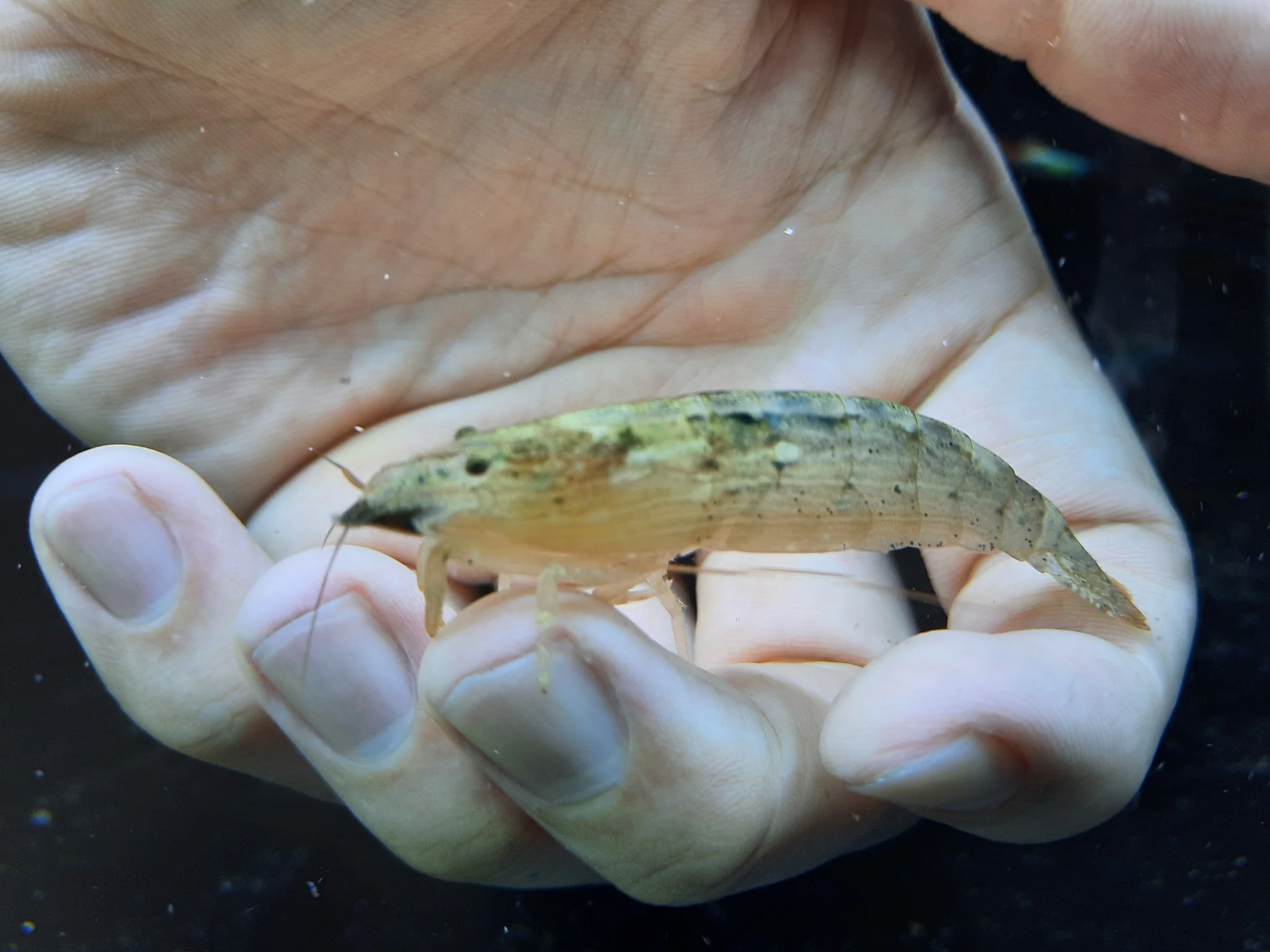

Bamboo Shrimp Problems: Common Causes of Stress, Death and Poor Growth
A bamboo shrimp that sits motionless, won't eat, or dies within days of arrival usually isn't sick in the traditional sense — it's almost always a husbandry mismatch. This species has a filter-feeding lifestyle that's completely different from a dwarf shrimp or algae eater, and most "sudden" deaths trace back to a handful of predictable, fixable causes. Below is a symptom-by-symptom breakdown of what typically goes wrong and how to correct it.
What is a bamboo shrimp?
The bamboo shrimp (Atyopsis moluccensis) is also sold as the wood, fan, flower, or Singapore shrimp. It's one of the larger freshwater aquarium shrimp, reaching 3–4 inches (8–10 cm), with a long, striped body in brown, tan, green, or reddish tones and a pale stripe down the back.
Its most important feature isn't visible until you look closely: instead of front claws, it has four pairs of fan-like feeding appendages. It opens these fans into moving water to strain out suspended particles — biofilm, algae fragments, and fine organic debris. This single anatomical fact explains almost every common problem owners run into, because it means the shrimp cannot pick up food from the substrate and cannot survive in stagnant water.
The single biggest cause of problems: inadequate water flow
Bamboo shrimp are obligate filter feeders. Without enough current carrying particles past their perch, they physically cannot feed — even in a tank stocked with plenty of food for other animals. A shrimp placed in a calm, low-flow tank will extend its fans occasionally, catch almost nothing, and slowly starve over a period of weeks, not days. That slow timeline is exactly why the problem is often missed until the shrimp is already in poor shape.
A simple home flow test: sprinkle a pinch of fine food powder or a bit of substrate dust upstream of the shrimp's chosen perch. If you can visibly see it drifting past the fans in a steady stream, flow is adequate. If it settles or barely moves, the current isn't reaching the shrimp.
Fixes:
- Aim a filter outflow or a small powerhead directly across a perch point (a piece of driftwood, a rock, or a corner of hardscape).
- Favor longer, wider tanks over tall ones — a longer footprint gives current more room to travel in a usable, sustained path rather than dissipating quickly.
- In multi-shrimp setups, provide several distinct current paths, since bamboo shrimp can be territorial over a good feeding spot and will displace each other from a single prime perch.
You can browse suitable outflow and circulation options in FishyHub's filters category.
Feeding problems and starvation
Because bamboo shrimp can't manipulate food with claws, dropping in whole sinking pellets does nothing for them — the food either goes untouched (fouling the water) or is eaten by other tankmates while the shrimp gets nothing.
What actually works:
- Powdered spirulina, crushed flake, crushed fry food, or liquid fry food, poured into the current a short distance upstream of the shrimp so it drifts past the fans.
- Feed 2–3 times a week in newer or sparsely stocked tanks.
- In a mature, well-established tank with biofilm and suspended detritus, supplemental feeding can be reduced — the ambient particulate load may be enough on its own.
Watch for the two opposite mistakes: overfeeding (excess powder clouding the water and spiking ammonia) and underfeeding (assuming the shrimp is fine because it "looks like it's eating" when flow is too weak to deliver anything at all).
Sudden death after introduction
A bamboo shrimp dying within the first 24–72 hours of arriving home is almost always acclimation shock or a water toxin, not disease.
Acclimation shock: Invertebrates tolerate sudden pH, temperature, or hardness swings far worse than most fish. A quick float-and-dump introduction can trigger fatal osmotic shock. Use a slow drip acclimation, letting water mix gradually over 30–60+ minutes (longer for shrimp shipped from very different water parameters) rather than just floating the bag and pouring the shrimp in.
Copper exposure: Shrimp are extremely sensitive to copper, and even trace amounts are lethal. Common hidden sources include:
- Some liquid plant fertilizers used in planted tanks
- Certain fish medications
- Tap water drawn through old copper piping
Before adding a bamboo shrimp, check fertilizer and medication labels for copper, and treat tap water with a conditioner. A water conditioner and additive that neutralizes chlorine, chloramine, and heavy metals is worth using on every water change, since chloramine in particular doesn't off-gas the way chlorine does and needs to be chemically neutralized.
Molting: normal behavior that looks like a crisis
Adult bamboo shrimp molt roughly every 4–8 weeks, more frequently while young and actively growing. Before and after a molt, it's completely normal for the shrimp to:
- Stop eating
- Hide for 12–48 hours
- Appear pale or duller than usual
Don't panic-treat a shrimp that's simply pre- or post-molt. Give it 24–48 hours before assuming illness. Interestingly, unlike many other shrimp species, bamboo shrimp typically don't eat their own shed exoskeleton — leaving it in the tank is harmless either way, since it can serve as a calcium source if the shrimp does return to it, or you can remove it after a day or two.
Genuine failed molt vs. normal shed: A normal molt leaves an intact, translucent, hollow shell shape with no shrimp inside. A failed molt looks different — the shrimp is visibly stuck partway out of the old exoskeleton, often at the head or tail, and unable to fully free itself; this is frequently fatal without intervention and points to underlying mineral deficiency rather than a random event.
Poor growth and failed molts
If a bamboo shrimp seems stunted, isn't molting on schedule, or dies mid-molt, the usual suspects are:
| Likely cause | What to check | Fix |
|---|---|---|
| Low calcium/GH | Test general hardness | Target GH 4–8; consider a mineral supplement/remineralizer |
| Unstable parameters | Log temp, pH, GH over a week | Prioritize stability over hitting an exact number |
| Insufficient food reaching the shrimp | Re-run the flow test | Reposition outflow, add a powerhead, feed more consistently |
| Old age | Lifespan is commonly 4–6 years | Slower growth/activity can simply be natural aging |
Note that bamboo shrimp do not reproduce in freshwater home aquariums — their larvae require brackish or marine water to develop. A stable adult population that never increases in number is not a symptom of anything wrong; it's expected.
Water quality basics that apply to every symptom
Bamboo shrimp are more sensitive to ammonia, nitrite, and dissolved metals than most community fish, and these problems are invisible without testing.
Target parameters:
- Temperature: 72–82°F (22–28°C), with the mid-70s often cited as an ideal middle ground
- pH: 6.5–7.5
- GH: 4–8 (moderate hardness)
- KH: stable (exact number matters less than consistency)
- Ammonia and nitrite: 0
- Nitrate: kept low via regular water changes
A tank must be fully cycled (0 ammonia, 0 nitrite) before any shrimp goes in — this applies to bamboo shrimp exactly as it does to dwarf shrimp, snails, or any other freshwater invertebrate. Skipping this step is one of the most common beginner mistakes in the hobby generally, not just with this species.
Housing and tankmate mistakes
- Minimum tank size: 10 gallons (38 L), with longer/wider footprints preferred so current can be directed effectively.
- Full aquatic species: bamboo shrimp cannot tolerate emersion and may climb during molting or poor conditions — a tight-fitting lid is essential.
- Tankmates: peaceful community fish are fine; avoid fin-nippers, shrimp-eating cichlids or loaches, and crayfish or other predatory invertebrates that will harass or eat them.
- Social structure: keep singly, or in groups without competition over prime current spots — territorial disputes over the best feeding perch are common when flow paths are limited.
Explore compatible species and stock in FishyHub's shrimp category.
Planaria and other tank-health signals
Flatworms (planaria) commonly hitchhike in on plants or substrate. A visible population explosion is usually a sign of overfeeding or excess organic waste rather than a threat on its own — adult bamboo shrimp are mostly unbothered by them. However, planaria can prey on shrimp eggs, juveniles, and weakened or freshly molted shrimp with a soft shell.
Manage planaria with:
- Reduced feeding and better organic waste control
- Manual siphoning or trap-based removal
- Caution with chemical dewormers — a mass die-off can crash ammonia levels and harm sensitive invertebrates, so mechanical removal is generally the safer first step
Frequently Asked Questions
Why did my bamboo shrimp die suddenly after I added it?
The most likely causes are acclimation shock from a rapid temperature or pH swing, or exposure to a toxin such as copper, chlorine, chloramine, or leftover medication in the water. Review how the shrimp was acclimated and whether any fertilizer, medication, or new tap water was recently introduced.
Why is my bamboo shrimp not moving or just sitting in one spot?
Check current strength first — inadequate flow means the shrimp can't feed and will stay still with its fans barely extended. Brief stillness is also normal around a molt, but prolonged inactivity with fans not deployed usually points to weak flow or stress rather than a molt cycle.
What do I feed a bamboo shrimp if it won't eat pellets?
Since it can't manipulate whole pellets, feed powdered spirulina, crushed flake or fry food, or liquid fry food poured into the current upstream of its perch. A mature, well-stocked tank also supplies suspended microfauna and detritus that reduce how much supplemental feeding is needed.
Is it normal for my bamboo shrimp to disappear or hide for a day or two?
Yes — this is typical pre- or post-molt behavior lasting roughly 12–48 hours. Check back after that window and look for a shed exoskeleton as confirmation before assuming a health problem.
Can bamboo shrimp live with fish?
Yes, they do well with peaceful community fish. Avoid known fin-nippers, shrimp-eating cichlids or loaches, and any fish or invertebrate large enough to predate them.
Why isn't my bamboo shrimp growing or molting?
This is usually caused by insufficient food actually reaching the shrimp due to weak flow, low GH/calcium, or unstable water parameters. Re-check current strength with a visual flow test and test GH before assuming an unrelated illness.
Will my bamboo shrimp breed in my tank?
No — their larvae require brackish or marine water to develop, so a freshwater home aquarium will never produce viable offspring. A stable adult that isn't reproducing is not a sign of a health issue.
Once flow, feeding, and water stability are dialed in, bamboo shrimp are a hardy, long-lived addition — often living 4–6 years — that add movement and character to a planted or community tank. Browse FishyHub's full range of freshwater invertebrates in the freshwater livestock category to find compatible tankmates for your setup.


