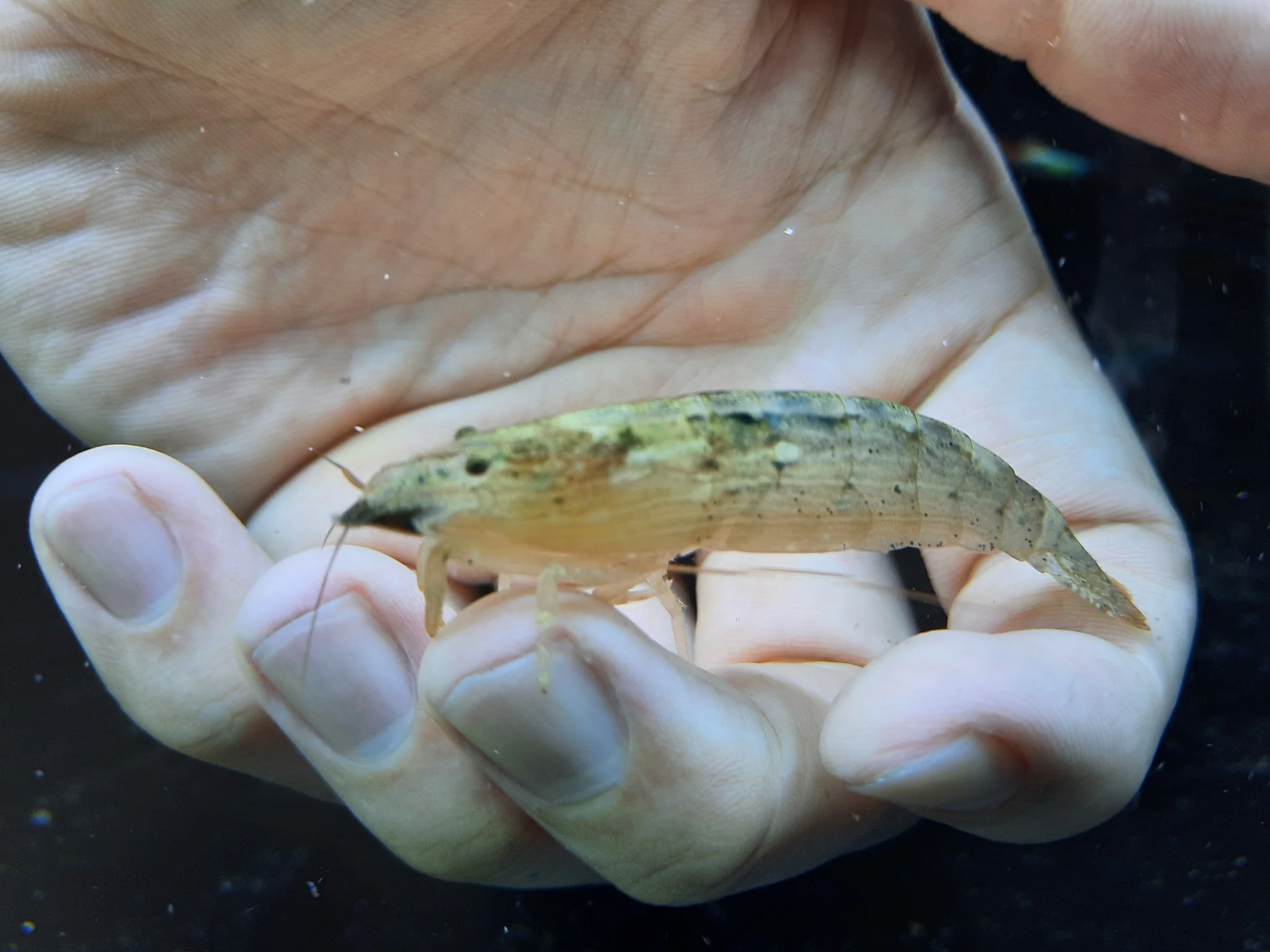
Bamboo Shrimp Care Guide: Setup, Feeding, Water Parameters and Breeding
Bamboo shrimp (Atyopsis moluccensis) are gentle, oddly built freshwater invertebrates that catch food from the current instead of picking it up like ordinary shrimp. This guide covers the tank setup, flow, water parameters, and feeding routine they actually need, plus why breeding them at home almost never works.
What Is a Bamboo Shrimp?
The bamboo shrimp's scientific name is Atyopsis moluccensis, but it's sold under several common names: fan shrimp, wood shrimp, flower shrimp, and Singapore shrimp. These are all the same species (or very closely related Atyopsis species) marketed differently — not distinct animals. In the wild, they live in fast-flowing streams and rivers across Southeast Asia, which explains almost everything unusual about their care.
Adults reach 2–3 inches (5–8 cm) in body length with a thick, sturdy body in shades of brown, tan, or reddish-orange, often with a pale stripe running down the back. Their most distinctive feature is a pair of fan-shaped feeding appendages (setae) on the front legs — feathery, net-like structures used to strain drifting food particles from the water. Their other, rear walking legs still carry small pincers, but those are used for gripping surfaces and grooming, not for grabbing food.
Bamboo Shrimp vs. Vampire Shrimp and Other "Filter Feeders"
Shoppers often see "vampire shrimp" and "green lace shrimp" listed alongside bamboo shrimp and assume they're interchangeable. They're closely related but not identical:
- Bamboo shrimp / fan shrimp / flower shrimp — all trade names generally applied to Atyopsis moluccensis, native to Southeast Asia.
- Vampire shrimp — usually refers to Atya gabonensis, an African filter feeder that's larger and often grayish-purple, but uses the same fan-feeding strategy and needs nearly identical care.
Because trade names overlap and aren't standardized, it's worth confirming the scientific name at the point of purchase if you want to know exactly which species you're getting.
Tank Setup
Tank Size
A 20-gallon (76 L) long or wide tank is the comfortable recommended minimum for one bamboo shrimp. A 10-gallon (38 L) tank can work as an absolute floor for a single specimen, but only with strong, well-distributed current. Shape matters more than depth here: a long, low tank spreads horizontal flow across more surface area than a tall, narrow one, giving the shrimp more places to perch in the current.
If you're keeping more than one, add roughly 10–15 extra gallons per additional shrimp as a conservative guideline (some sources go as low as 5, others as high as 20 — err generous). Bamboo shrimp aren't territorial with each other, but each one needs its own reliable stretch of current to feed from, so overcrowding limits how much food reaches each individual.
Substrate, Decor, and Perches
Use sand or fine gravel as a base, then build in:
- Driftwood — a preferred perching spot directly in the flow
- Rocks for additional surface area
- Dense live plants, which grow biofilm the shrimp can graze between feedings and help stabilize water quality
The goal is to give the shrimp multiple elevated perches — driftwood, plant stems, rock edges, or the area near a filter outlet — where it can extend its fans into moving water.
Flow and Aeration: The Most Important Factor
Flow is not optional for a filter feeder — it's the single biggest factor in whether a bamboo shrimp thrives or starves. It needs moderate-to-strong, steady current from a filter outlet, a powerhead, or an airstone paired with a sponge filter to continuously carry suspended particles past its fans.
Good surface agitation and oxygenation matter just as much: low dissolved oxygen stresses bamboo shrimp quickly, and unlike fish, they can't easily move to better-oxygenated water in a small tank. Because a filter or power failure can halt both flow and oxygen at once, a backup air pump and airstone running independently is a smart, low-cost safeguard — stalled flow and low oxygen are two of the fastest ways to lose this species.
Water Parameters
Bamboo shrimp are more sensitive to water quality swings than most community fish, and sources vary somewhat on exact numbers. The table below reconciles the commonly cited ranges with a practical target.
| Parameter | Safe Range | Recommended Target |
|---|---|---|
| Temperature | 70–84°F (21–29°C) | 75–80°F (24–27°C) |
| pH | 6.5–7.5 (tolerate outliers if stable) | 6.5–7.5 |
| General Hardness (GH) | 4–8 dGH | 5–7 dGH |
| Carbonate Hardness (KH) | 2–6 dKH (up to 10 dKH in some sources) | 3–5 dKH |
| TDS | ~150–200 ppm | 150–200 ppm |
| Ammonia | 0 ppm, always | 0 ppm |
| Nitrite | 0 ppm, always | 0 ppm |
| Nitrate | Under 20 ppm | Under 10–15 ppm |
Stability matters more than hitting an exact number. A shrimp living comfortably at 6.8 pH for months is safer than one bounced between 6.8 and 7.6 within a week. Test regularly rather than assuming parameters hold steady.
New Tank Cycling Comes First
Never add bamboo shrimp to a new or uncycled tank — this is the single leading cause of early death for the species. A tank needs a fully established nitrogen cycle (0 ppm ammonia, 0 ppm nitrite, with nitrate being produced) before any sensitive invertebrate goes in. Fishless cycling — dosing ammonia and letting beneficial bacteria colonize the filter media over roughly 30–60 days — is the standard way to get there. Skipping this step and adding shrimp to "settle in" a new tank routinely ends in an ammonia or nitrite spike the shrimp can't survive.
Common Water Issues to Watch
Three issues cause most water-quality problems for shrimp keepers:
- Ammonia/nitrite spikes from an uncycled or overstocked tank — always fatal-in-waiting for invertebrates.
- pH swings, often from inconsistent water changes or reactive substrates — test before and after changes.
- Chlorine and chloramine in tap water, which are highly toxic to shrimp — always treat new water with a dechlorinator before it touches the tank.
Feeding: Why Bamboo Shrimp Are Different
This is the part most new owners get wrong. Bamboo shrimp are true filter feeders — their fan-shaped setae are built to net drifting particles out of moving water, not to grasp solid food off the substrate. Their rear legs still have small pincers, but those exist for perching and grooming, not for handling food the way a cherry shrimp or Amano shrimp would. Drop a sinking pellet or algae wafer in front of a bamboo shrimp and it largely can't use it — this mismatch between anatomy and typical shrimp food is the root of most feeding problems.
What to Feed
Since they need suspended micro-particles, not solid chunks, feed:
- Powdered or crushed flake food
- Powdered spirulina or algae food
- Baby brine shrimp (live or frozen)
- Finely crushed pellets
- Small live or frozen foods like daphnia
A well-planted, mature tank also generates biofilm and infusoria that supply meaningful nutrition between feedings, which is another reason established tanks support bamboo shrimp better than new ones.
The Target-Feeding Technique
Because a normal feeding dish doesn't work for this species, use a turkey baster, large syringe, or pipette to mix powdered food with a bit of tank water and squirt it directly into the current a few inches upstream of the shrimp's fans. Feed small amounts 2–3 times per week rather than one large daily dose — filter feeders process a steady trickle of particles more efficiently than a big slug of food dumped at once. Many keepers find it easiest to feed right as lights go out or come on, when the shrimp are typically most active and positioned in the flow.
Watch shrimp behavior as your feedback loop: a shrimp actively perched with fans extended into the current is feeding normally. A shrimp that's abandoned its perch to forage along the substrate is a sign there isn't enough food suspended in the water column — treat it as an early underfeeding warning, not a personality quirk.
If you keep bamboo shrimp alongside faster-eating fish, target feeding solves most of the competition problem automatically, since you're delivering food directly to the shrimp rather than relying on scraps. The bigger risk isn't fish stealing food — it's simply not putting enough particulate matter into the water column in the first place.
A note for mixed shrimp tanks: bamboo shrimp themselves won't eat blanched vegetables, but tankmates like cherry or bee shrimp benefit from blanched zucchini, spinach, or cucumber left in for 12–24 hours before removal. That's a supplement for your other shrimp, not part of a bamboo shrimp's core diet.
Tank Mates
Bamboo shrimp are peaceful and completely non-territorial, using their fans only to feed — never to defend themselves. Good tank mates include:
- Small, calm community fish: tetras, rasboras, danios, livebearers, gouramis, corydoras
- Other peaceful shrimp: cherry shrimp, Amano shrimp, bee shrimp (no crossbreeding risk between species)
- Peaceful snails
Avoid crayfish, crabs, cichlids, puffers, and any large, predatory, or nippy fish that treat shrimp as food — this is especially dangerous right after a molt, when a bamboo shrimp's new shell is soft and it can't defend or flee effectively.
You can browse compatible options for a mixed setup in FishyHub's shrimp category or check calmer betta varieties suited to shrimp tanks in the betta selection.
Molting
Molting is a normal, recurring event — expect it roughly every 4–8 weeks. Before and after a molt, a bamboo shrimp may hide, look pale, and stay unusually inactive for a short period. It will typically eat its own shed exoskeleton afterward to reclaim calcium, so leave the shed skin in the tank rather than removing it.
Inactivity lasting more than about two days after a molt (or unexplained lethargy generally) is not normal and signals an underlying problem: poor water quality, low oxygen, insufficient food in the water column, or stress from tankmates. Check parameters and flow first before assuming it's just recovering from a molt.
Lifespan
Bamboo shrimp typically live 1–2 years in captivity, occasionally longer under especially stable, well-maintained conditions.
Breeding: Why It Practically Doesn't Happen at Home
Females do carry eggs and release free-swimming larvae, and it's natural to wonder if a home tank can raise them. In practice, breeding bamboo shrimp in a standard freshwater aquarium doesn't work, and understanding the biology explains why.
Bamboo shrimp have an amphidromous life cycle, similar to Amano shrimp and many other freshwater atyid shrimp. The larvae are planktonic and must develop through several stages in brackish or marine salinity before they can transform into juveniles capable of living in fresh water again. In their native rivers, larvae drift downstream to estuaries or coastal water to complete this stage, then migrate back upstream as juveniles. A standard freshwater home aquarium has no equivalent environment, so larvae released in fresh water simply don't survive to the next stage.
Because of this two-stage life cycle, virtually all bamboo shrimp sold in the aquarium trade are wild-caught, not captive-bred. That's also a reason to inspect specimens carefully before buying: since these are wild-collected animals, check that all legs and both feeding fans are intact. A shrimp with a missing or damaged fan can't feed properly and often declines slowly even in a perfectly maintained tank.
Sensitivities and Acclimation
Like most invertebrates, bamboo shrimp are extremely intolerant of copper-based medications. If a tankmate needs copper treatment, remove the shrimp to a separate container first — copper that's safe for fish can be lethal to shrimp at very low concentrations.
They're also sensitive to sudden shifts in temperature, pH, or hardness. Skip the standard fish-store method of floating and mixing bag water over 15–20 minutes — that's too fast for an invertebrate. Instead, use slow drip acclimation over an hour or more, letting your tank's water parameters blend gradually into the bag or container water before the shrimp is introduced.
Common Mistakes
- Adding shrimp to an uncycled tank — the top cause of early death.
- Insufficient flow so food particles never reach the fans, causing slow starvation even in an otherwise healthy tank.
- Offering only sinking pellets or wafers, assuming bamboo shrimp eat like other shrimp species.
- Using copper medication with shrimp still in the tank.
- Mistaking a molt for a dead shrimp and discarding a shell that should be left for the shrimp to eat.
- Fast, standard acclimation instead of a slow drip method.
- Housing with aggressive or nippy fish, particularly risky right after a molt.
- Missing early starvation signs — a shrimp foraging on the substrate instead of perched in the current.
Frequently Asked Questions
Do bamboo shrimp eat algae?
No. They're filter feeders that strain suspended particles from the water column rather than grazing on algae growth, so don't expect them to control algae the way some snails or other shrimp species do.
Can bamboo shrimp live with betta fish?
Generally yes, since bamboo shrimp are slow-moving and non-aggressive, but temperament varies by individual betta. Watch a new pairing closely, since a nippy betta can still harass or injure a shrimp, especially post-molt.
Why is my bamboo shrimp not moving or hiding all the time?
The most common causes are molting, poor water quality or low oxygen, not enough food suspended in the water column, or stress from tankmates. Check flow and water parameters first, since these are the fastest things to fix.
How do I know if my bamboo shrimp is dead or just molted?
A molt leaves behind an empty, intact, translucent shell in the shape of the shrimp, with no animal inside. A dead shrimp discolors, develops an odor, goes limp, and typically doesn't leave a separate shell behind because it didn't shed — it's still inside its last exoskeleton.
Can bamboo shrimp breed in a freshwater tank?
Not practically. The larvae require brackish or marine salinity to develop through their early life stages, and they won't survive that transition in a standard freshwater setup, which is why almost all bamboo shrimp in the trade are wild-caught.
What do I feed a bamboo shrimp if I don't have live foods?
Powdered flake food, finely crushed pellets, or powdered spirulina/algae food mixed with a little tank water works well. Load it into a turkey baster or syringe and squirt it directly into the current near the shrimp.
How many bamboo shrimp can I keep together?
Several can share a large enough tank with strong, well-distributed flow, since they aren't territorial toward their own species. The limiting factor is food and current access — an overcrowded tank means less suspended food reaches each individual.
If you're setting up a tank for bamboo shrimp or looking for compatible tank mates, browse the current selection of freshwater invertebrates in FishyHub's shrimp category.

