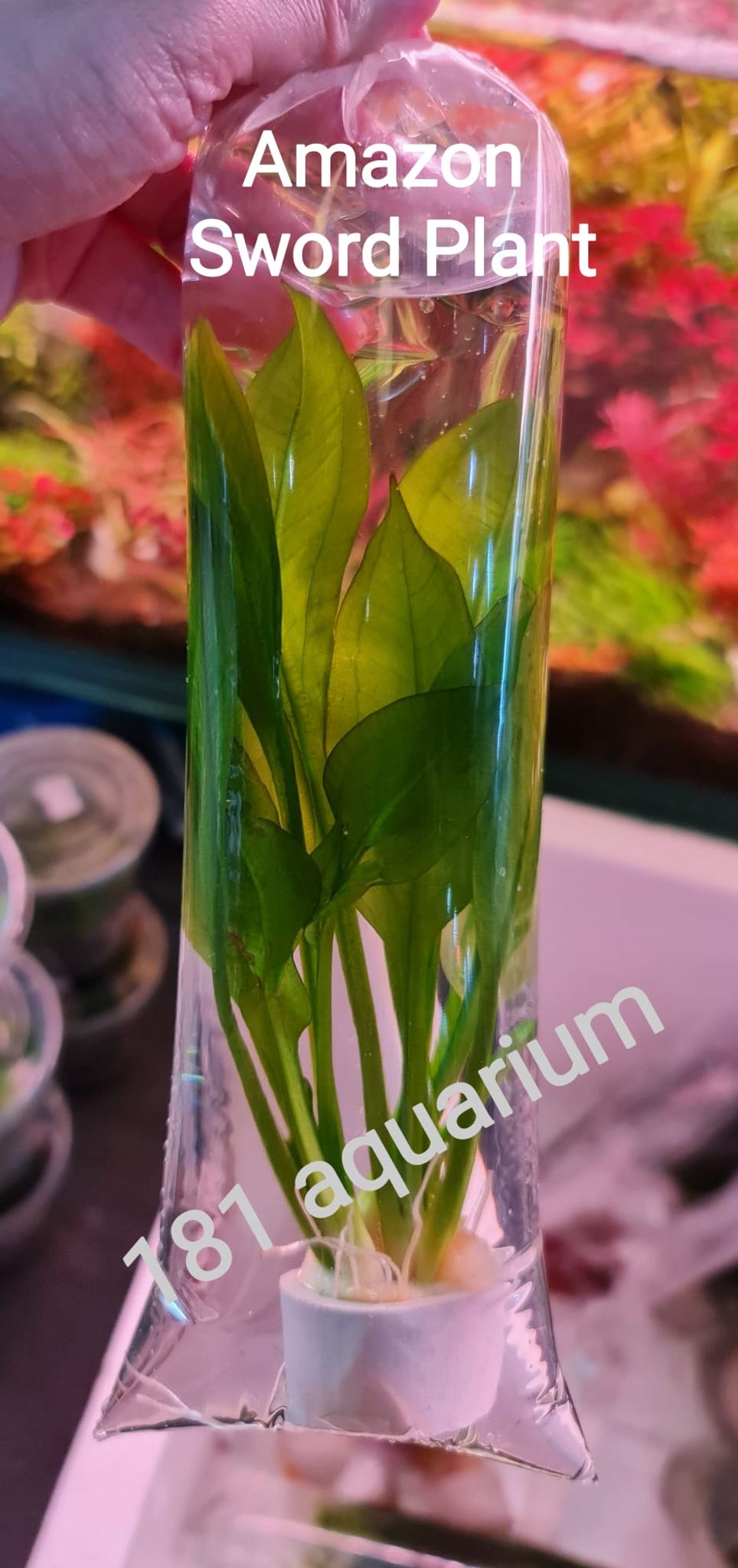
Amazon Sword Care Guide: Light, CO2, Substrate and Growth Tips
The Amazon sword is one of the most forgiving centerpiece plants in the freshwater hobby, but most of the confusion around it comes down to three questions: how much light does it really need, is CO2 required, and what substrate will actually make it thrive. This guide lays out a clear minimum-viable setup versus an optimal one, plus a troubleshooting section for melting, yellowing, and stalled growth.
What Is an Amazon Sword, Exactly?
"Amazon sword" is a common name usually applied to two closely related species, Echinodorus bleheri and Echinodorus amazonicus, which are frequently sold interchangeably under the same label. Both are broad-leafed, rosette-forming plants from South American waterways and are cared for the same way, so the distinction rarely matters for a home aquarium.
Several colorful cultivars share the sword family name but behave differently:
- Red Rubin and Red Flame – reddish-bronze leaves
- Ozelot – green leaves with dark speckling
- Melon Sword – lighter green, rounded leaf shape
This guide focuses on the classic green Amazon sword, though the core care parameters apply broadly across the group.
Tank Size and Water Parameters
Amazon sword can technically be kept in a 10-gallon (38 L) tank while young, but it quickly outgrows small footprints. A mature plant reaches 15 to 20+ inches (38–51 cm) tall and nearly as wide, so a 20-gallon (76 L) tank or larger is a much better long-term fit, especially for tanks meant to showcase it as a background or centerpiece plant.
| Parameter | Range | Sweet Spot |
|---|---|---|
| Temperature | 68–82°F (20–28°C) | 72–78°F (22–26°C) |
| pH | 6.5–7.5 | Neutral (7.0) |
| General hardness | ~3–15 dGH | Moderate |
| Minimum tank size | 10 gal (38 L) | 20 gal (76 L)+ |
A practical note for US keepers: municipal tap water hardness varies a lot region to region, and some supplies run noticeably harder or softer than the plant's comfortable middle range. If your local water sits near either extreme, that's a reason to pay closer attention to micronutrient dosing rather than to avoid the plant altogether.
Light Requirements
Amazon sword survives on low light, which is why it's often recommended to beginners as an "easy" plant. But it grows fuller, greener, and noticeably faster under moderate light, so treat moderate as the target and low light as an acceptable floor rather than the ideal.
- Photoperiod: 8–12 hours per day, with 10–12 hours commonly used
- Low light: plant survives, growth is slow and leaves stay smaller
- Moderate to high light: faster growth, larger leaves, more prolific runners
- Colored cultivars (red or aurea/golden variants): need higher light specifically to hold their color — under low light they tend to revert toward green over time
You can browse fixtures suited to either approach in FishyHub's lighting category.
Does Amazon Sword Need CO2?
No. Amazon sword is a classic low-tech plant that grows well without injected CO2 as long as the substrate supplies adequate nutrients. Think of CO2 (injected or liquid carbon) as a growth accelerant rather than a requirement: it speeds up leaf production and increases leaf size, and it becomes more useful once you're running high light, since more light without extra carbon and nutrients tends to invite algae instead of plant growth. If you're keeping the tank low-tech with moderate light, skip CO2 without worry.
Substrate: The Most Important Factor
More than light or CO2, substrate quality determines how well an Amazon sword performs, because it's a heavy root feeder that pulls most of its nutrition through its roots rather than the water column.
Key substrate guidelines:
- Depth: at least 2–3 inches (5–7.5 cm); deeper is better for such a large root system
- Grain size: fine-to-medium works best for anchoring roots; very coarse gravel makes rooting harder
- Plain gravel or sand: workable, but needs root tabs added to supply nutrients
- Nutrient-rich aquasoil: gives the best unassisted growth without relying as heavily on tabs
Choosing a Substrate for This Plant
| Substrate type | Root anchoring | Built-in nutrients | Best paired with |
|---|---|---|---|
| Sand | Good | None | Root tabs required |
| Standard gravel | Fair to good | None | Root tabs required |
| Nutrient-rich aquasoil | Good | High | Light or no additional root tabs |
If you're starting from scratch, review options in the substrate category, including plain gravel and sand or a nutrient-rich planted soil, and match your choice to the fertilizing plan below.
A Simple Decision Framework
Instead of juggling every fertilizing option at once, pick one lane based on your substrate:
- Inert substrate (plain gravel or sand) → push a root tab near the root base every 1–3 months, and consider a light liquid all-in-one fertilizer for general plant health. Root tabs are not optional here — without them, growth stalls and leaves pale out.
- Nutrient-rich aquasoil → root tabs are optional rather than mandatory. A heavily stocked tank with good bioload can supply enough nutrients through fish waste alone, though tabs still help once growth visibly slows.
- High-light or CO2-injected tank with several large sword plants → consider Estimative Index (EI) dosing (explained below) to avoid ever nutrient-limiting the plants.
Fertilizing: Macros, Micros, and Root Tabs
Aquarium plant nutrients fall into two broad groups:
- Macronutrients – nitrogen, phosphorus, and potassium, which drive overall growth and leaf structure
- Micronutrients – iron, manganese, magnesium, and other trace elements, which drive leaf color and chlorophyll production and prevent yellowing
Root tabs mainly deliver macros plus iron directly to the root zone, which is exactly where an Amazon sword feeds. Liquid water-column fertilizers top up micronutrients for every plant in the tank, including new leaf growth, but for this species root tabs matter more than they would for a stem plant that feeds mostly through its leaves.
Root Tabs vs. Liquid Fertilizer
| Feature | Root tabs | Liquid fertilizer |
|---|---|---|
| Delivery point | Root zone | Water column |
| Duration | Weeks to months | Days |
| Best for | Heavy root feeders like Amazon sword | Stem plants, general micros |
| Water change impact | Unaffected | Leaches out, needs re-dosing |
Many planted tanks use both: root tabs for the sword's root system and a liquid all-in-one to keep the rest of the tank's plants supplied.
DIY Root Tabs
Some hobbyists press a granular, slow-release fertilizer into small clay balls or capsules as a cheaper homemade alternative to commercial root tabs. This works, but check the label carefully and avoid copper-heavy formulas if you keep shrimp, since copper is toxic to invertebrates even at low doses.
Mycorrhizae: An Optional Boost
Mycorrhizal fungi can be mixed into substrate or added alongside root tabs to improve nutrient and water uptake at the root hairs. It's an emerging practice in the planted-tank hobby rather than an established requirement — worth trying if you want to experiment, but not something an Amazon sword needs to survive.
Estimative Index Dosing (Advanced, Optional)
The Estimative Index (EI) method was developed within the high-tech, CO2-injected planted tank community in the 1990s and 2000s as a way to remove nutrient guesswork. The idea is straightforward: deliberately dose macro and micronutrients weekly at levels well above what the plants could possibly use, then reset the water chemistry with a large water change — commonly around 50% — so nutrients never run low and never build up to harmful excess.
EI is optional and mainly useful for high-light, CO2-injected, sword-heavy aquascapes where you want maximum growth rate. Most Amazon sword keepers running a standard low-tech setup don't need it — a simpler root tab plus light liquid fert routine, with weekly 20–25% water changes, works fine.
Water Changes
Weekly water changes of about 20–25% keep nutrient buildup and algae in check and maintain the clean water Amazon sword prefers — it doesn't tolerate polluted or stagnant conditions well. Tanks running EI dosing use larger changes, often up to 50%, but that's a function of the dosing method, not a contradiction of the general guideline.
Growth Rate and Propagation
Given adequate nutrients, Amazon sword grows at a moderate-to-fast pace and can become one of the largest plants in a community aquarium. Plan on regular trimming of older, outer leaves as the plant matures.
Propagation happens two ways:
- Runners/stolons: mature plants send out horizontal runners bearing small plantlets. Once a plantlet develops its own roots and a few leaves, cut the runner and replant it elsewhere, or leave it in place to form a colony.
- Crown division: a slower method where a mature crown is split into sections, each capable of rooting independently.
Placement and Spacing
Because of its eventual size, Amazon sword works best as a background or centerpiece specimen, not a foreground plant. Leave 8–12 inches (20–30 cm) of clearance around it so it can reach full spread without shading or crowding neighboring plants. When planning an aquascape, position it where its height won't block sightlines to smaller plants or hardscape features in front of it.
Don't Confuse It With: Chain Sword
Despite the shared name, chain sword (Helanthium tenellus, also called Echinodorus tenellus) is a completely different growth habit — a small, grass-like carpeting plant rather than a tall centerpiece. It spreads via runners like its larger cousin, needs medium light to carpet well, and stays only a couple of inches tall. If you're shopping for a foreground carpet plant, chain sword is the one to look for; if you want a tall background specimen, that's the true Amazon sword.
Fish and Invertebrate Compatibility
Amazon sword coexists well with most peaceful community fish and shrimp, including small tetras, corydoras, and other bottom dwellers you'll find in FishyHub's plecos, corys, and bottom dwellers category. Avoid pairing it with fish known for digging or plant grazing, such as large cichlids or goldfish, which can uproot the plant repeatedly or shred its leaves. If you keep digging species, anchor a newly planted sword with a rock or two around the base until roots establish.
Common Mistakes and Troubleshooting
| Problem | Likely cause | Fix |
|---|---|---|
| Crown rotting | Rhizome buried too deep in substrate | Replant with crown at or just above the substrate line, roots buried, leaf bases exposed |
| Stunted, pale growth | Inert gravel with no root tabs or fertilizer | Add root tabs on a 1–3 month schedule |
| Neighboring plants shaded out | Overcrowding without accounting for mature size | Space Amazon sword 8–12 inches from other plants |
| New leaves yellow | Iron/micronutrient deficiency | Add root tabs and/or a liquid trace fertilizer |
| Older leaves yellow or holey | Potassium or nitrogen deficiency | Increase macro dosing via root tabs or liquid fert |
| Leaves melting after planting | Transition shock, common with tissue-cultured or emersed-grown stock | Trim melted leaves, keep water clean; new growth should come in healthier |
| Algae on leaves | Excess light, insufficient nutrient uptake, or dirty water | Check water change schedule and photoperiod before blaming the plant |
| Plant repeatedly uprooted | Digging or grazing fish | Anchor with rocks initially, or rehome digging species |
| Lower tank areas shaded | Neglected trimming of large outer leaves | Trim regularly as the plant matures |
A Simple Maintenance Calendar
- Weekly: 20–25% water change; check for melting or yellowing leaves; trim any dead or dying outer leaves
- Monthly: inspect for new runners and separate rooted plantlets if desired; assess overall color and growth rate
- Every 1–3 months: replace or add root tabs, especially in gravel or sand substrates
Frequently Asked Questions
Does Amazon sword need CO2?
No. It grows fine without injected CO2 as long as the substrate supplies adequate nutrients. CO2 mainly speeds up growth and is most useful in high-light setups.
Does Amazon sword need root tabs?
Not strictly, but they're strongly recommended in plain gravel or sand substrates. They matter less in a nutrient-rich aquasoil or a heavily stocked tank with good bioload, though they still help once growth slows.
How big does an Amazon sword get, and will it outgrow my tank?
It can reach 15–20+ inches (38–51 cm) tall and nearly as wide, making it a good fit for 20-gallon-plus tanks. In small nano tanks it will feel cramped and dominate the space quickly.
Why are my Amazon sword leaves turning yellow or see-through?
This is usually a nutrient deficiency — iron and micronutrients if new leaves are affected, potassium or nitrogen if it's older leaves — or transplant melting after the plant adjusts to submersed growth. Check your fertilizing routine and give it a couple of weeks before assuming the worst.
Can Amazon sword grow in low light?
Yes, it tolerates and survives in low light, but it grows fuller and faster under moderate light. Colored cultivars especially need more light to hold their color.
How do I propagate Amazon sword?
Let a runner's plantlet develop its own roots and a few leaves, then cut it from the parent runner and replant it elsewhere, or leave it in place to form a colony over time.
What's the difference between Amazon sword and chain sword?
Chain sword (Helanthium tenellus) is a small, grass-like carpeting plant, not the same species or growth habit as the tall Amazon sword. They share part of a common name but serve very different roles in an aquascape.
How often should I fertilize or replace root tabs?
Roughly every 1–3 months, or sooner if growth visibly slows. Pair root tab schedules with weekly partial water changes to keep the rest of the tank's water quality stable.
Ready to set up a planted tank around an Amazon sword? Browse substrate options built for root feeders in FishyHub's substrate category and pick the foundation that matches your fertilizing plan.

