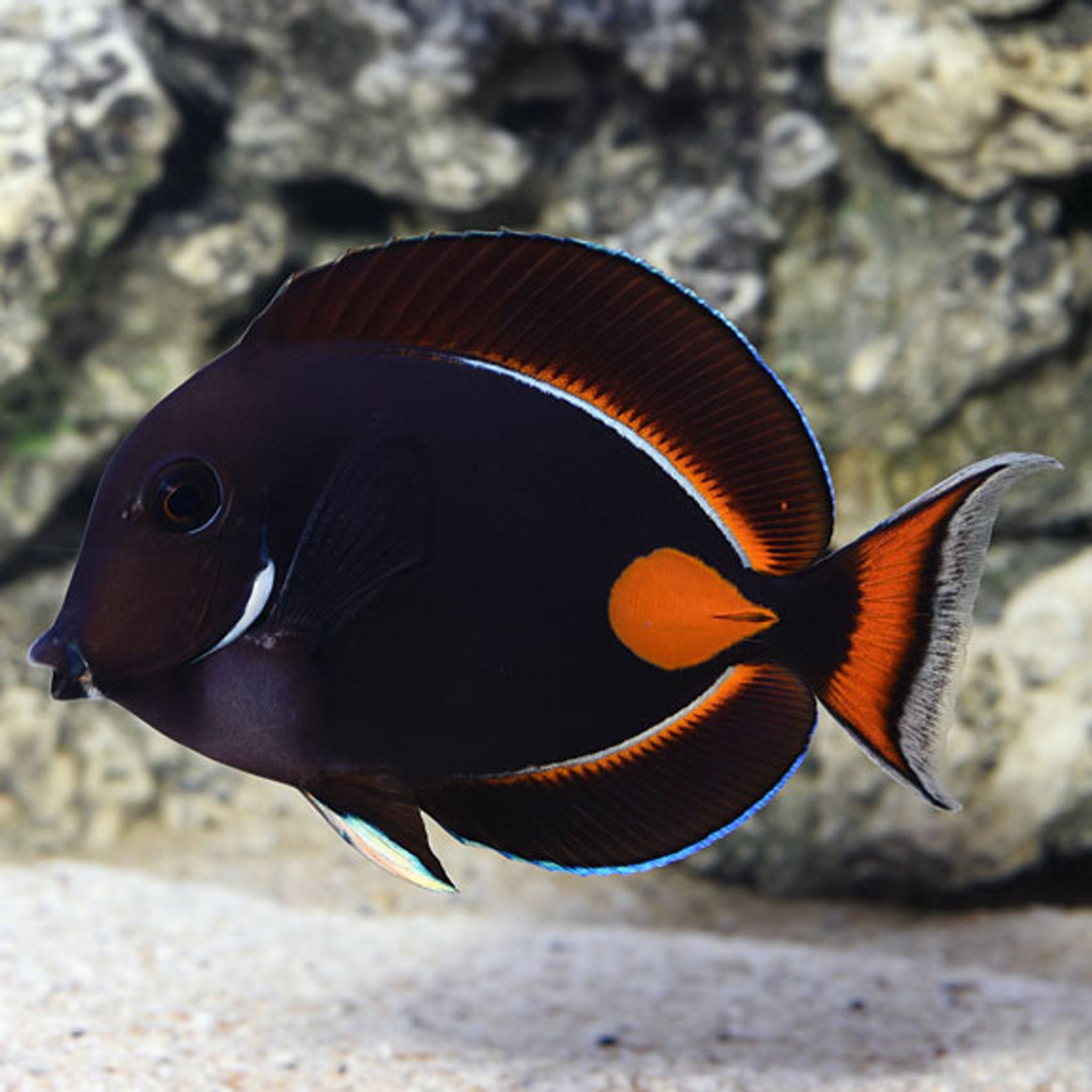
Achilles Tang Care Guide: Tank Size, Diet, Compatibility and Reef Safety
The Achilles tang (Acanthurus achilles) is one of the most visually striking surgeonfish in the hobby and also one of the least forgiving. This guide lays out the real tank size, water quality, diet, and quarantine requirements so you can decide honestly whether your system — and your experience level — are ready for one.
Species Snapshot
The Achilles tang is a wild-caught-only species collected from high-energy outer reef slopes across the Pacific, from Hawaii to French Polynesia. There is no captive-bred supply in the trade, so every specimen you see for sale has come through a chain of collection, shipping, and holding that directly affects how it performs once it reaches your tank.
Key facts:
- Adult size: 8–10 inches
- Identifying marks: a bold orange "comma" patch and an orange caudal spine (the scalpel) at the base of the tail, used defensively against other fish
- Habitat: shallow, surge-swept outer reef edges with constant turbulent current
- Lifespan: well over a decade in stable, well-fed systems, with reports of 10–20 years
- Difficulty rating: expert/advanced only — not a first marine fish, and not a fish to transition into saltwater with
Tank Size and System Maturity
This is a fish built for constant motion in open water, and undersizing the tank is the single fastest way to kill one.
- Absolute minimum: 125 gallons (473 L), and only in a long, wide footprint that gives real swimming distance
- Realistic minimum: 180+ gallons (680+ L) — treat this as the actual starting point, especially if you ever plan to add a second tang
- System age: the tank should be well-established, ideally 6–12 months old at minimum, with mature live rock for the fish to graze on. A newly cycled tank does not have the microbial stability or grazing surface this species needs.
Sources disagree on where the true floor sits. Some list 125 gallons as acceptable; others insist on 180 gallons or more given how much continuous swimming room the fish needs. The sensible reading: 125 gallons is a bare-minimum footprint for a single specimen in an otherwise ideal, mature setup, while 180+ gallons is what you should actually be planning around.
Water Parameters
Achilles tangs demand pristine, highly oxygenated, turbulent water that mimics their surge-zone origin. Stability matters as much as the numbers themselves.
| Parameter | Target Range |
|---|---|
| Temperature | 74–80°F (23–27°C) |
| Salinity (SG) | 1.023–1.025 |
| pH | 8.1–8.4 |
| Alkalinity | 8–12 dKH |
| Ammonia / Nitrite | 0 ppm |
| Nitrate | Under 10 ppm |
Nitrate tolerance is another point of disagreement across sources, with some citing "under 20 ppm" as acceptable. Given how sensitive this species is, it's worth erring toward the stricter, reef-tank-grade end and keeping nitrate under 10 ppm rather than testing the upper limit.
Beyond chemistry, the fish needs:
- Strong, turbulent, multidirectional flow — not a gentle laminar current
- An oversized protein skimmer relative to bioload
- High dissolved oxygen, which strong flow and skimming both support
Sump Basics for Stability
A sump — a secondary tank plumbed below or behind the display — houses the skimmer, heater, and return pump out of sight while adding total system water volume. More total volume means parameter swings happen slower and are easier to correct, which matters enormously for a fish this intolerant of instability. A sump also gives you room to add a refugium or dosing equipment later without redesigning the display.
DC vs. AC Return Pumps
The pump feeding your display and skimmer chamber affects how well you can tune flow:
| Feature | AC Return Pump | DC Return Pump |
|---|---|---|
| Upfront cost | Lower | Higher |
| Energy efficiency | Lower | Higher |
| Noise | Typically louder | Typically quieter |
| Flow control | Usually fixed | Variable/controllable |
For a species that needs precisely tuned turbulent flow, a DC pump is the better long-term investment — the variable control lets you dial in surge-like movement without oversizing plumbing just to get enough turnover.
Diet and Feeding
Achilles tangs are near-constant grazers in the wild and need frequent access to greens in captivity.
- Base diet: nori or seaweed sheets clipped into the tank daily, spirulina-based flakes or pellets, marine-algae blends
- Variety: frozen herbivore preparations, with occasional mysis or brine shrimp added for enrichment
- Frequency: 2–3 or more small feedings per day rather than one large meal
Inadequate greens quickly leads to two visible problems: hole-in-the-head disease (HLLE) and a "pinched belly" appearance from emaciation. If you already see early HLLE symptoms, steps beyond simply "feed more vegetables" help:
- Soak foods in a vitamin supplement before feeding
- Run activated carbon to improve water quality
- Rule out stray electrical voltage in the tank as a contributing factor
You can browse marine fish and herbivore-friendly foods on FishyHub while planning a feeding rotation that keeps greens available around the clock.
Temperament and Compatibility
Achilles tangs are semi-aggressive and strongly territorial toward other tangs, surgeonfish, and any fish competing for the same algae-grazing niche. They're generally fine alongside non-competing, peaceful fish such as anthias, chromis, wrasses, gobies, blennies, and angelfish.
Stocking guidance:
- Add the Achilles tang last, or near-last — after territorial and semi-aggressive fish are already settled, but before extremely peaceful newcomers that could get bullied by an established tang
- Keep it as the only tang in the system unless the tank is 300+ gallons, in which case dissimilar-shaped, dissimilar-colored tangs can sometimes be added simultaneously
- Avoid pairing it with other Acanthurus species of similar body shape or color — that similarity is exactly what triggers territorial aggression
Related Tang Species
If an Achilles tang feels like too much fish for your system, several relatives offer an easier entry point into the same body plan and grazing behavior.
| Species | Adult Size | Minimum Tank | Relative Difficulty |
|---|---|---|---|
| Achilles tang | 8–10 in | 125–180+ gal | Expert only |
| Powder brown / maculiceps tang | 8–10 in | 120–150 gal | Moderate–advanced |
| Orange shoulder (olivaceus) tang | Up to 13–14 in | 150–180 gal | Moderate, hardier |
| Fowler's tang | 9–10 in | 150–180 gal | Moderate, hardier |
All are herbivorous grazers from the same genus and need comparably large tanks, but they're generally calmer and more disease-resistant than the Achilles tang, making them worth considering as a first tang.
Naso Tangs as a Larger-Growing Alternative
Naso tangs are worth mentioning as a contrast point since shoppers researching Achilles tangs often compare the two. Some Naso species grow up to 18 inches and need 180–300+ gallon systems — even bigger than an Achilles tang's requirements — but depending on species they're planktivorous as well as herbivorous, and most are considerably hardier and more disease-resistant. Explore the full tangs and surgeonfish selection to compare options side by side.
Reef Safety
The Achilles tang is reef-safe: it does not eat or otherwise bother corals or typical reef invertebrates. Most sources call it unambiguously reef-safe, though a few caveat that framing to "established reef systems only" because of the fish's flow and bioload demands.
That caveat is the more useful way to think about it. Coral compatibility isn't really the limiting factor — tank maturity, water quality, and the strong turbulent flow this fish needs (which can stress certain coral placements if not planned around) are. Treat those as your real reef-tank checklist items rather than worrying about direct predation.
Disease Susceptibility and Quarantine
This is arguably the most important section for anyone considering this fish: Achilles tangs are among the most disease-prone marine fish in the hobby, and marine ich (Cryptocaryon irritans) is the primary threat, especially under stress or in anything less than pristine water.
Non-negotiable steps:
- Quarantine for 4+ weeks minimum before any display-tank introduction
- Many keepers recommend a prophylactic treatment protocol during QT — copper-based medication or hyposalinity, following an approved dosing schedule — rather than waiting for visible symptoms to appear
- A UV sterilizer on the display system is widely recommended as an ongoing risk-reducer, even though it's not strictly mandatory
Marine Ich Treatment and Freshwater Dips
If ich does appear, standard treatment happens in a separate quarantine or hospital tank using copper-based medication or hyposalinity — never dose copper directly in a display reef tank, since it's lethal to invertebrates and corals. A freshwater dip (fresh water matched to the display's pH and temperature, for a few minutes) can help dislodge some external parasites before quarantine begins, but it is a supplement to a full QT and treatment course, not a substitute for one. Given how quickly this species can crash once parasites take hold, rigorous QT isn't optional — it's the difference between a fish that thrives for a decade and one that dies in its first month.
Sourcing and Acclimation
Because there's no captive-bred supply, every Achilles tang is a wild-collected animal, and sourcing quality matters as much as anything you do at home:
- Buy specimens that are already eating and, ideally, already quarantined by the seller
- Ask about collection and shipping history where possible — this is a species where QT history at the point of sale genuinely affects survival odds
- At introduction, dim the lights, offer food immediately, and provide plenty of rockwork hiding spots to reduce stress-related immune suppression
Switching Marine Salt Mixes
If you ever change salt brands — whether for cost, availability, or water quality reasons — do it gradually across several water changes rather than switching all at once. Different brands carry different trace element and buffering profiles, and an abrupt switch can cause a parameter swing right when a sensitive fish is already stressed from shipping or acclimation. Test alkalinity, calcium, magnesium, and salinity after the transition and adjust dosing as needed to keep things stable.
Should You Graduate to Saltwater With This Fish?
Freshwater experience helps you understand cycling, water testing, and husbandry discipline, but it isn't mandatory for moving into marine keeping. What actually determines readiness is:
- Research depth before buying any livestock
- Budget for a genuinely large tank and the equipment (skimmer, UV, strong return pump) it needs
- Patience with the nitrogen cycle and a slow, deliberate stocking pace
- Access to a knowledgeable source for troubleshooting when something goes wrong
An Achilles tang is not the fish to start a first saltwater tank with, full stop. It's better suited as a "graduation" purchase once you've successfully run a mature reef or fish-only system for a year or more.
Cost and Total Ownership
Livestock price for an Achilles tang typically runs in the $500–650+ range, but that number is only part of the real cost. A 180-gallon-class system built to this fish's standards — display tank and stand, sump, an oversized skimmer, a UV sterilizer, and a DC return pump — represents a much larger investment than the fish itself. Budget for the full system before budgeting for the fish.
Decision Checklist: Don't Buy This Fish Unless...
- Your display tank is at least 125 gallons (180+ preferred) and has been running 6–12 months or longer
- You can maintain nitrate under 10 ppm and strong turbulent flow consistently
- You have a dedicated quarantine tank and are prepared to run a full 4+ week QT with prophylactic treatment
- You can commit to feeding greens 2–3+ times daily, indefinitely
- You're not planning to house it with another similarly shaped tang unless your tank exceeds 300 gallons
Common Mistakes to Avoid
- Buying for an undersized or immature tank — under 125 gallons or under 6 months old invites rapid stress, ich outbreaks, and death
- Skipping quarantine because the fish "looks healthy" — this species can crash fast once parasites establish
- Underfeeding greens or feeding only meaty foods — leads to HLLE, weight loss, and weakened immunity
- Adding another tang too soon, or before other territorial fish are settled — causes chronic stress and fighting
- Weak or laminar flow — this surge-zone fish needs strong, varied turbulent current, not gentle circulation
- Fixating on "reef safe" alone while ignoring tank size, flow, and maturity requirements that matter more
- Abruptly switching salt brands during an already-stressful acclimation period
Frequently Asked Questions
Is the Achilles tang reef safe?
Yes, it doesn't harm corals or typical reef invertebrates. The bigger consideration for a reef tank is whether your system's size, flow, and maturity can meet the fish's demanding requirements.
How big does an Achilles tang get?
Adults typically reach 8–10 inches, with the orange comma marking and caudal spine visible at maturity.
What is the minimum tank size for an Achilles tang?
125 gallons is treated as an absolute floor, and only in a long, open footprint. 180+ gallons is the realistic recommended starting point, especially if you ever plan to keep more than one tang.
Why do Achilles tangs die so often, or are they hard to keep?
They're extremely sensitive to water quality and highly prone to marine ich, largely because of wild-capture stress combined with a need for pristine, high-flow, high-oxygen water. This combination is why the species is considered expert-level only.
What do Achilles tangs eat?
Marine algae and nori, spirulina-based pellets or flakes, and marine-algae blends form the base diet, with occasional meaty foods like mysis or brine shrimp added for variety. Feed several small portions daily rather than one large meal.
Can Achilles tangs live with other tangs?
Only with careful planning — a large tank, dissimilar body shapes and colors, and simultaneous introduction all help reduce aggression. Avoid pairing with other Acanthurus species of similar shape or color.
Do I need a UV sterilizer or a sump for an Achilles tang?
Neither is strictly required, but both are commonly recommended for a species this disease-prone and quality-sensitive — a UV sterilizer for ongoing parasite control and a sump for added water volume and stability.
How do I quarantine a new Achilles tang?
Run a minimum of 4 weeks in a dedicated quarantine tank, ideally paired with a prophylactic parasite treatment protocol, before ever moving the fish to the display system.
If you've weighed the tank size, water quality, and quarantine commitment above and decided you're ready, browse FishyHub's tangs and surgeonfish category to compare available specimens and plan your stocking order.

